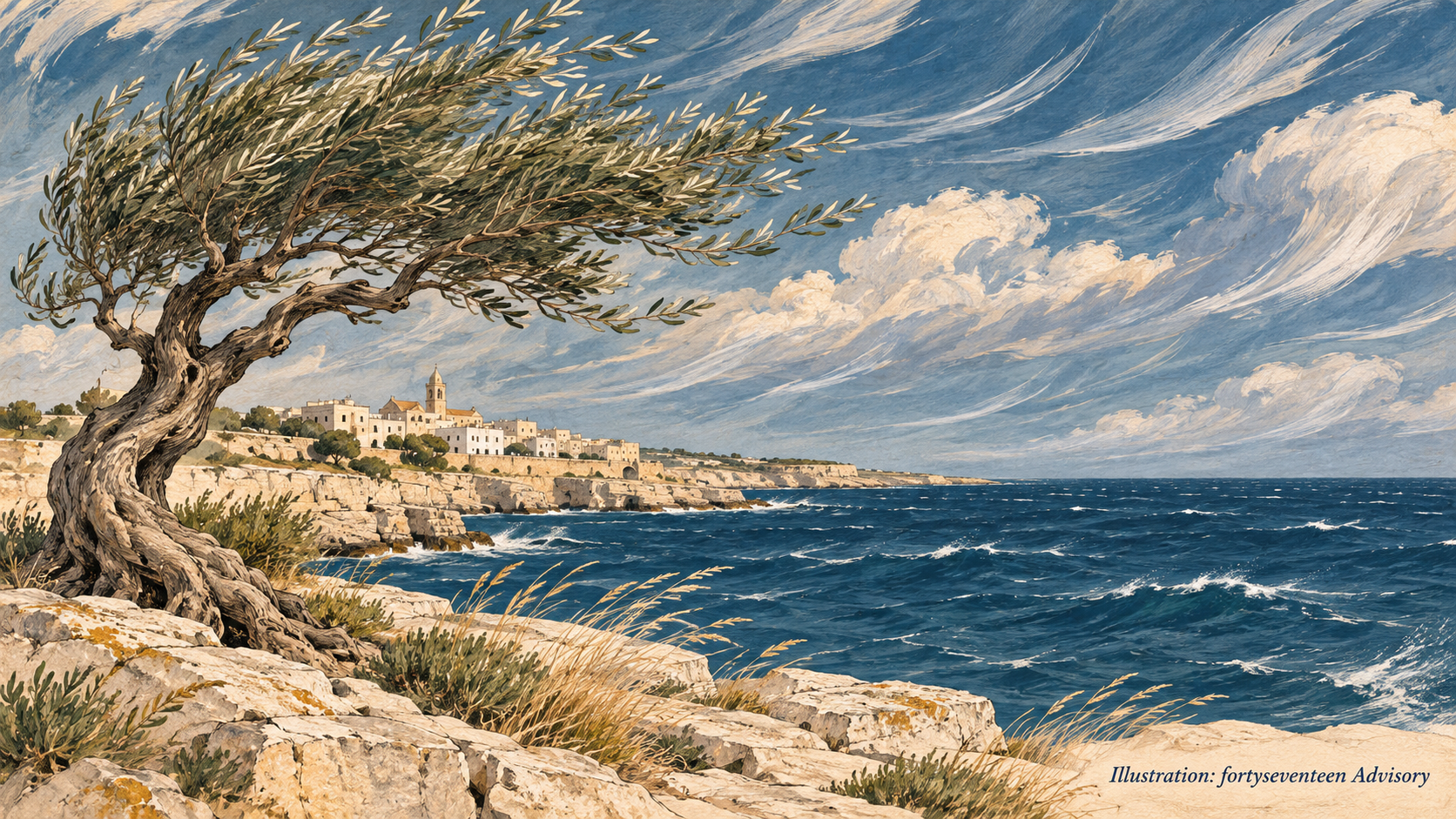
Illustration: fortyseventeen Advisory
In 37 BC the poet Horace travelled from Rome to Brindisi and recorded the moment the region came into view: Apulia showed him “her well-known mountains, which the Atabulus scorches” (Satires 1.5, translated by Christopher Smart). The Atabulus was a hot wind of Apulia.
Two thousand years later, the wind is still the first thing a Puglian morning is measured by.
Where the names come from
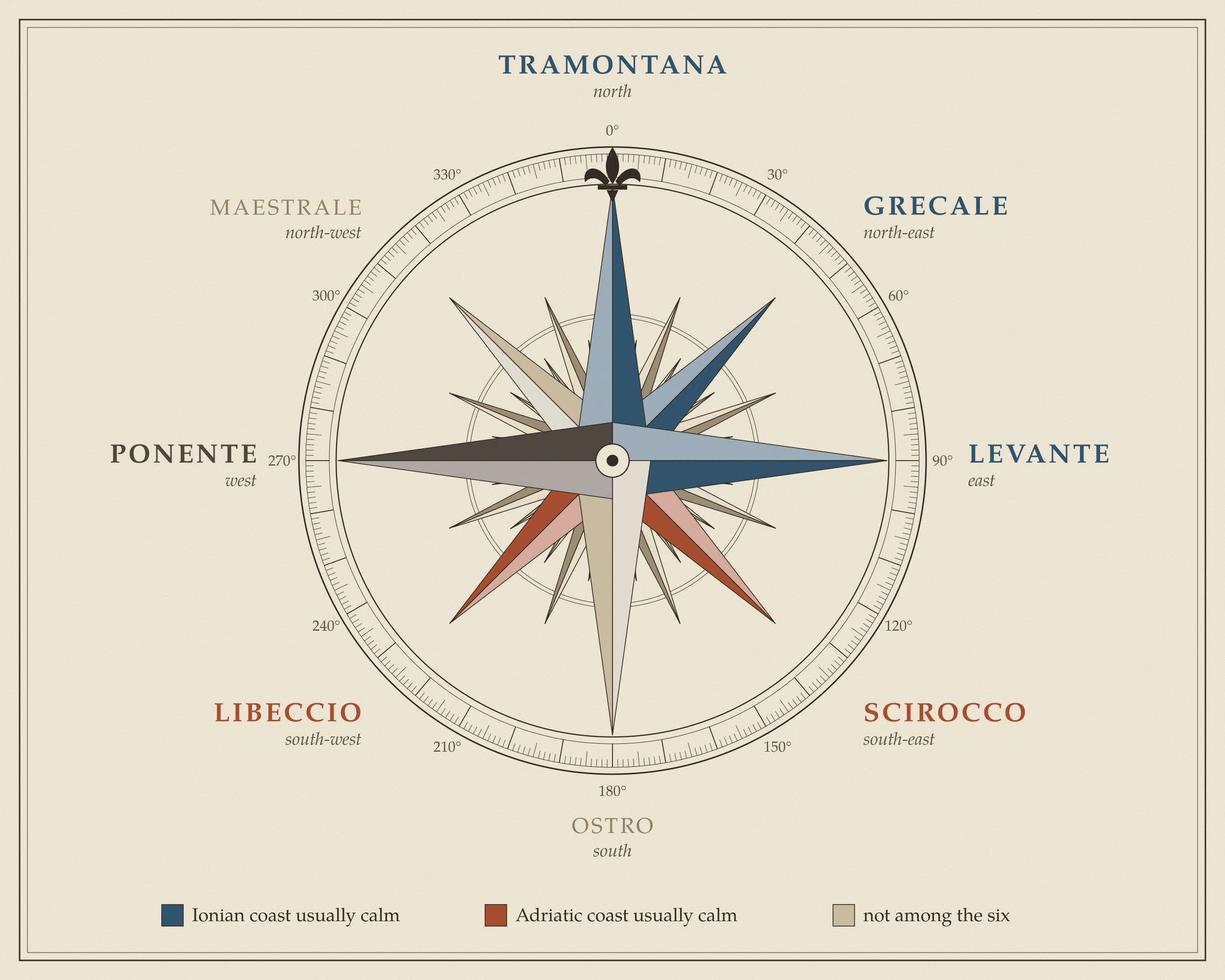
Mediterranean sailors divided the horizon into eight winds: Tramontana from the north, Greco from the north-east, Levante from the east, Scirocco from the south-east, Ostro from the south, Libeccio from the south-west, Ponente from the west and Maestro from the north-west.
The names are read from a single point at sea. Tradition sets the centre of the wind rose at the Greek island of Zakynthos, in the Ionian Sea, in the age of the Venetian Republic. From there Greece lies to the north-east, Libya to the south-west and Syria to the south-east.
In Salento, the southern end of the region, six of these names are in everyday use.
Tramontana, north. Cold and dry. It gave Italian the idiom perdere la tramontana, “to lose the north wind”, said of someone who has lost their bearings.
Grecale, north-east. Cold, from the direction of Greece.
Levante, east. Named for the rising sun.
Scirocco, south-east. Hot and humid. Puglia has a blunter name for it, Scorciacrape: the wind hot enough to skin goats.
Libeccio, south-west. With scirocco, a frequent source of heavy seas on the Ionian coast at Gallipoli.
Ponente, west. Named for the setting sun.
They do not blow equally often. One guide to the Salento coast notes that levante and grecale are rare.
The rule of the opposite coast
The peninsula is narrow: Lecce stands 13 km from the Adriatic and 28 km from the Ionian. Residents choose their beach each morning by a rule of thumb, which is to go to the coast the wind is not blowing onto. With winds from the north and east (tramontana, grecale, levante) the Ionian is usually calm. With winds from the south and west (scirocco, libeccio) the Adriatic is, especially between Lecce and Otranto.
The rule has critics. Money.it calls the simple version “as widespread as it is unfounded” and distinguishes one stretch from another: the Adriatic coast north of the Punta Palascìa lighthouse is the one it recommends with southerly winds.
One wind escapes the scheme altogether. The maestrale, from the north-west, runs parallel to the peninsula and is felt on both coasts.
What it means for a house
Measurements show which winds carry most weight. The design report for the Porto Gaio harbour at Gallipoli, filed with Italy’s environment ministry, identifies the winds from the north and north-north-west as both frequent and the strongest, and records frequent heavy seas from libeccio and scirocco.
For a buyer, a question of beach days becomes one of orientation: which façade faces north, which terrace is sheltered from the south-east, and how far the property stands from each sea.
Why now
Every wind in this article has been blowing since Horace. What has changed is who is listening.
Enquiries from international buyers for Puglia rose 62 per cent in a year, against 1.2 per cent for Tuscany, according to JamesEdition figures reported in 2025 from the Financial Times. The houses that face the right way, within reach of both seas, are a fixed number in a market that is no longer quiet.
Picture the first morning in a house of your own here. The shutters open on olive trees that were old before the house was built. Someone at the bar says tramontana, and you already know which road to take: west, to the Ionian, where the water will be flat and clear.
Within a week you stop checking the forecast and start reading the sky. Within a season you can tell the scirocco by the weight of the air before the curtains move. That is the day the house stops being an investment and becomes the place where you live.
The winds will be here either way. The only open question is whether you will be here to learn them.