
Masseria, trullo, lamia, palazzo and the other words that decide what you are buying.
There is a moment, usually on the second day, when a visitor to Puglia stops photographing the stone and starts asking who owns it. The white tower above the olive trees, the cone-roofed house at the end of a dirt track, the carved balcony over a quiet street in Lecce: each of them is somebody’s home, and some of them change hands.
This glossary is written for the reader who has reached that moment. It explains the words that recur in every Puglian listing, because here the word decides what is being bought: a room, a house, a farm, or several centuries of history with land around it.
Why invest here
The first question is always why, and the short answer is that these buildings cannot be made again, while the number of people looking for them grows.
Figures from JamesEdition, reported in 2025 from the Financial Times, show enquiries for Puglia rising 62 per cent in a year, against 1.2 per cent for Tuscany. Prime prices in the central area that includes the Valle d’Itria have risen 20 per cent since 2021, to about €3,500 per square metre; Chianti rose 6 per cent over the same period, to €4,000.
Americans, with French and German buyers, lead the market above €1 million, according to Francesco Distante of Puglia Dream, and a Four Seasons resort near Ostuni is expected by 2027. On the coast, idealista recorded average asking prices in Monopoli 8.9 per cent higher in July 2026 than a year earlier.
Numbers explain why the market is moving; they do not explain what is for sale. For that a buyer needs the vocabulary, and it begins with the smallest and most famous building of all.
The trullo
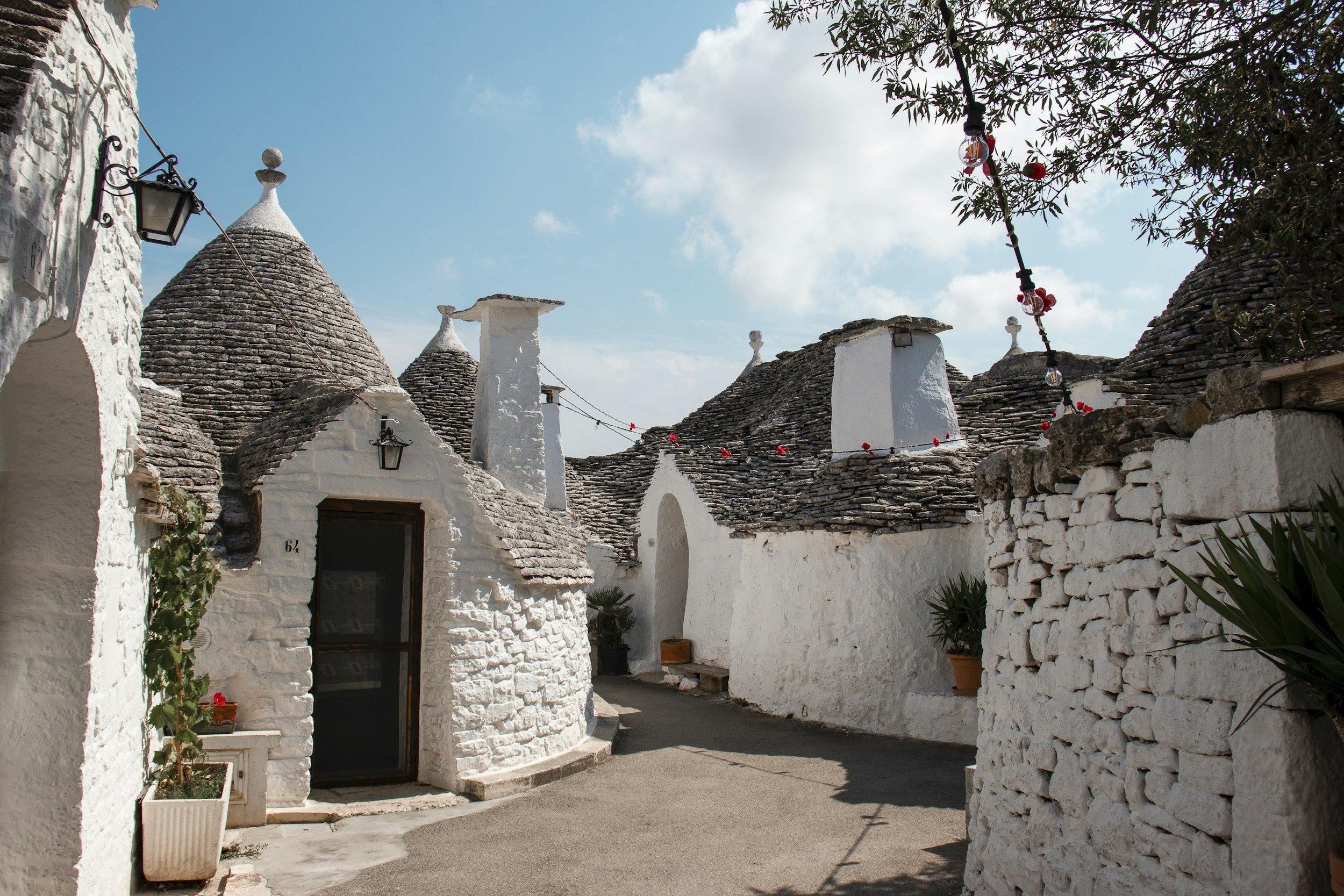
The trullo is the building most visitors picture first. UNESCO, which inscribed the trulli of Alberobello on the World Heritage List in 1996, describes them as limestone dwellings raised without mortar from boulders gathered in the neighbouring fields.
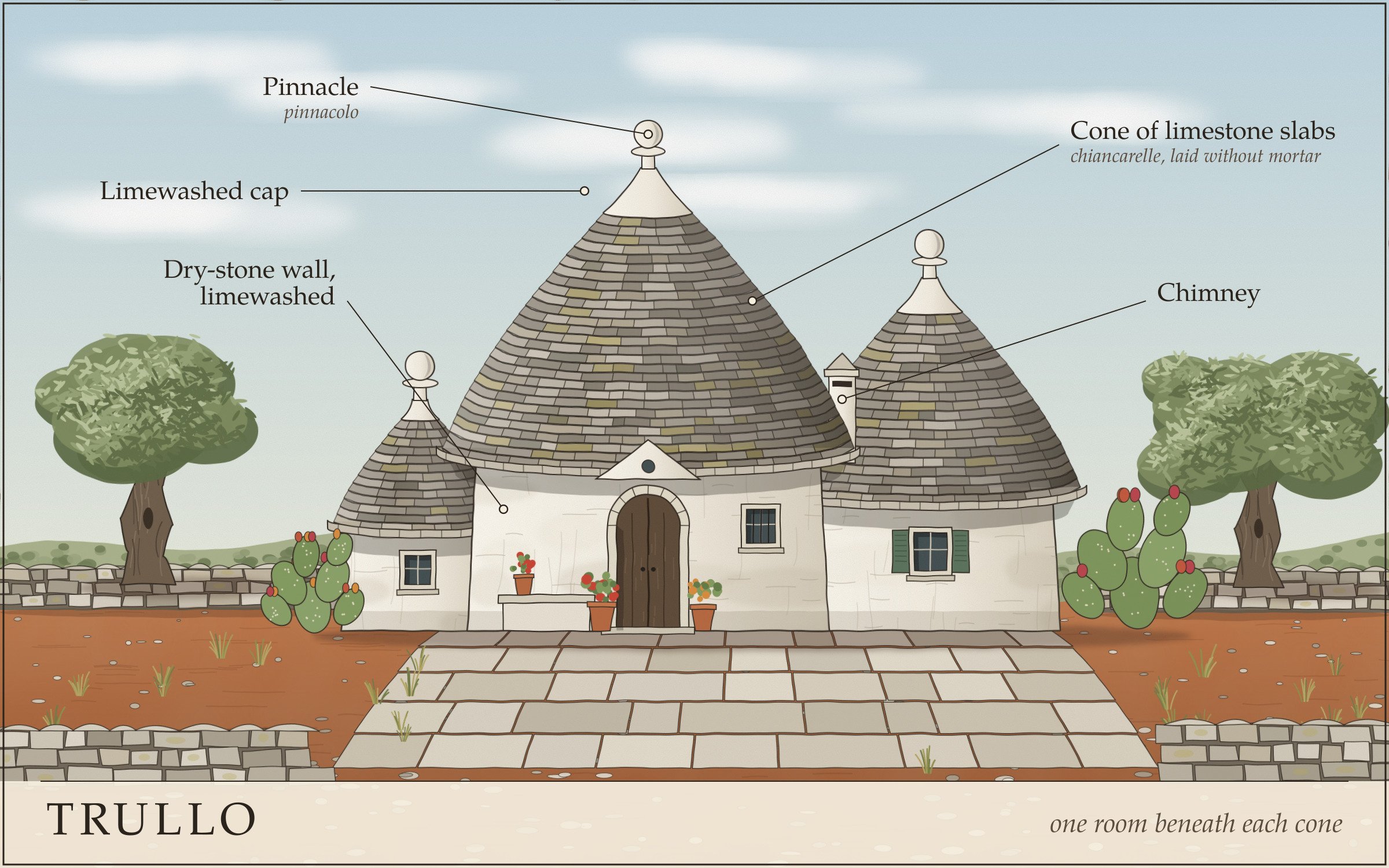
Illustration: fortyseventeen Advisory
The roof is the signature: an outer cone of overlapping stone slabs, called chianche or chiancarelle, laid over an inner dome. A dwelling is formed by combining two or more trulli, which is why listings count cones.
The oldest dated example, Trullo Marziolla near Locorotondo, carries the year 1559 on its lintel. Italy’s Ministry of Culture records that trulli served both as temporary field shelters and stores and as permanent homes for small landowners and farm labourers.

The lamia
The lamia is the trullo’s plainer neighbour, and the two often share a plot. It was built as temporary quarters for agricultural workers, or as a store for grain and fodder.
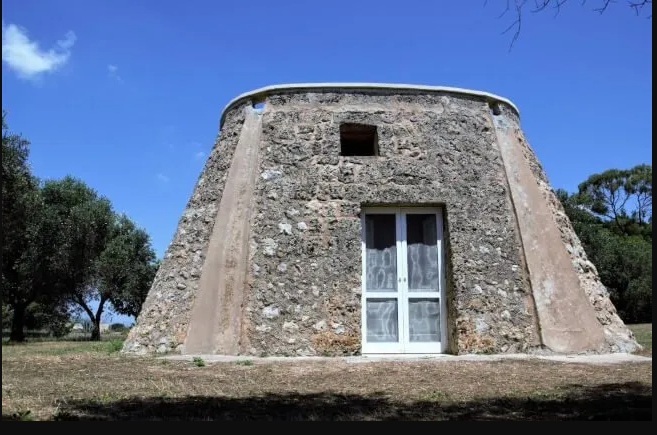
Lamia Uccio (foto booking.com)
Its plan is rectangular, with dry-stone walls and a barrel vault, and an outside stair often leads to a terrace roof. The regular rooms suit contemporary use.
In Trullo GN, a restoration by Reisarchitettura, the kitchen and dining room remain in the original trullo, while the living room and one bedroom occupy newly built lamie.
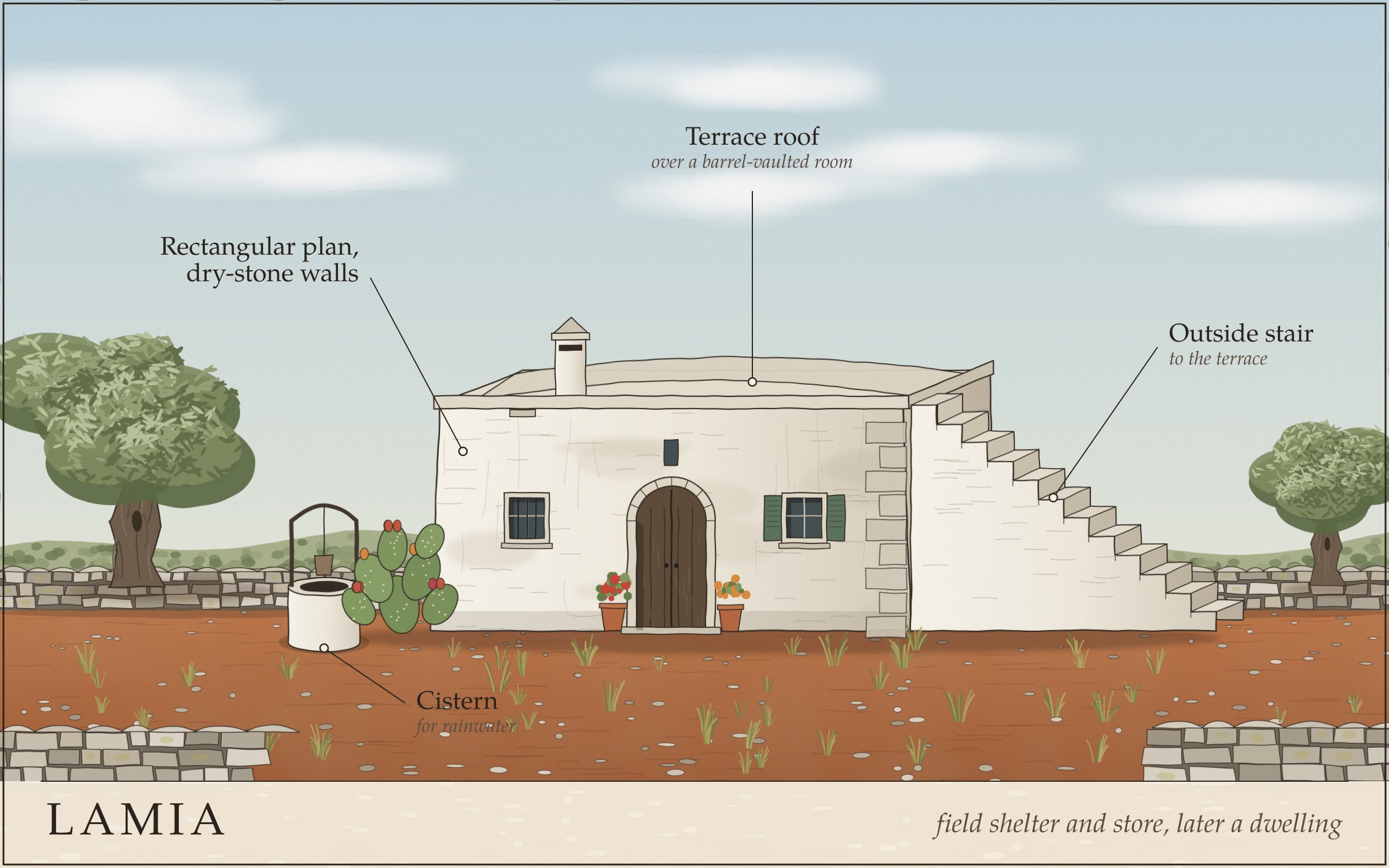
Illustration: fortyseventeen Advisory
The type belongs to the Valle d’Itria and the Alto Salento, and in its original state it is small. Listings describe a single room on one level under a barrel vault, with niches in the stonework and an old fireplace, often of no more than twenty or thirty square metres, and sometimes with its own cistern for collecting rainwater.
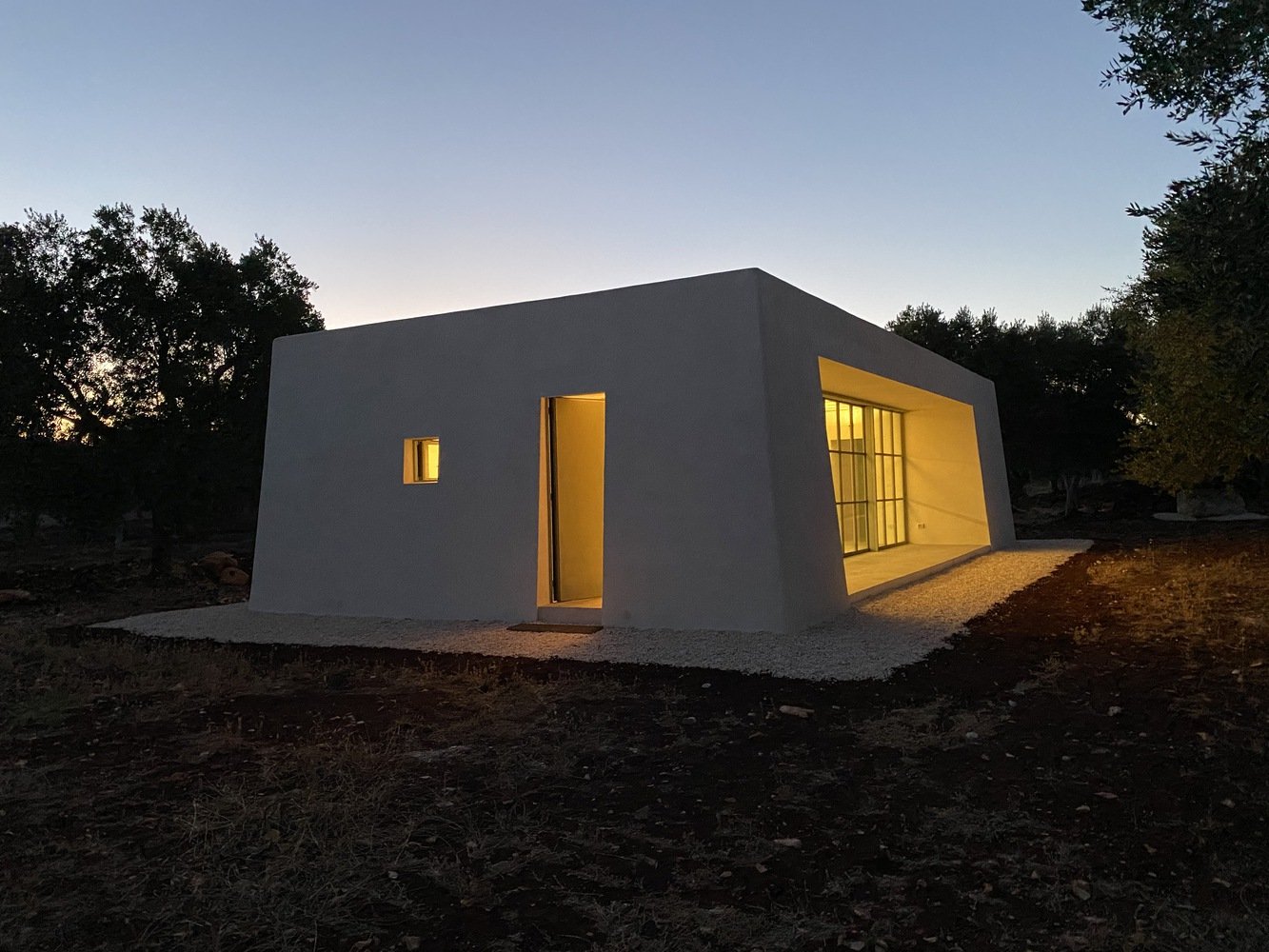
What it lacks in size it returns in proportion: thick walls, one vaulted space, a terrace for the evening. Contemporary architects have taken note. Near Carovigno, Lamia Santolina by YAS Architecture, commissioned by the artist Cosimo Terlizzi and his partner Damien Modolo, is a new house built on the lamia model.
The masseria
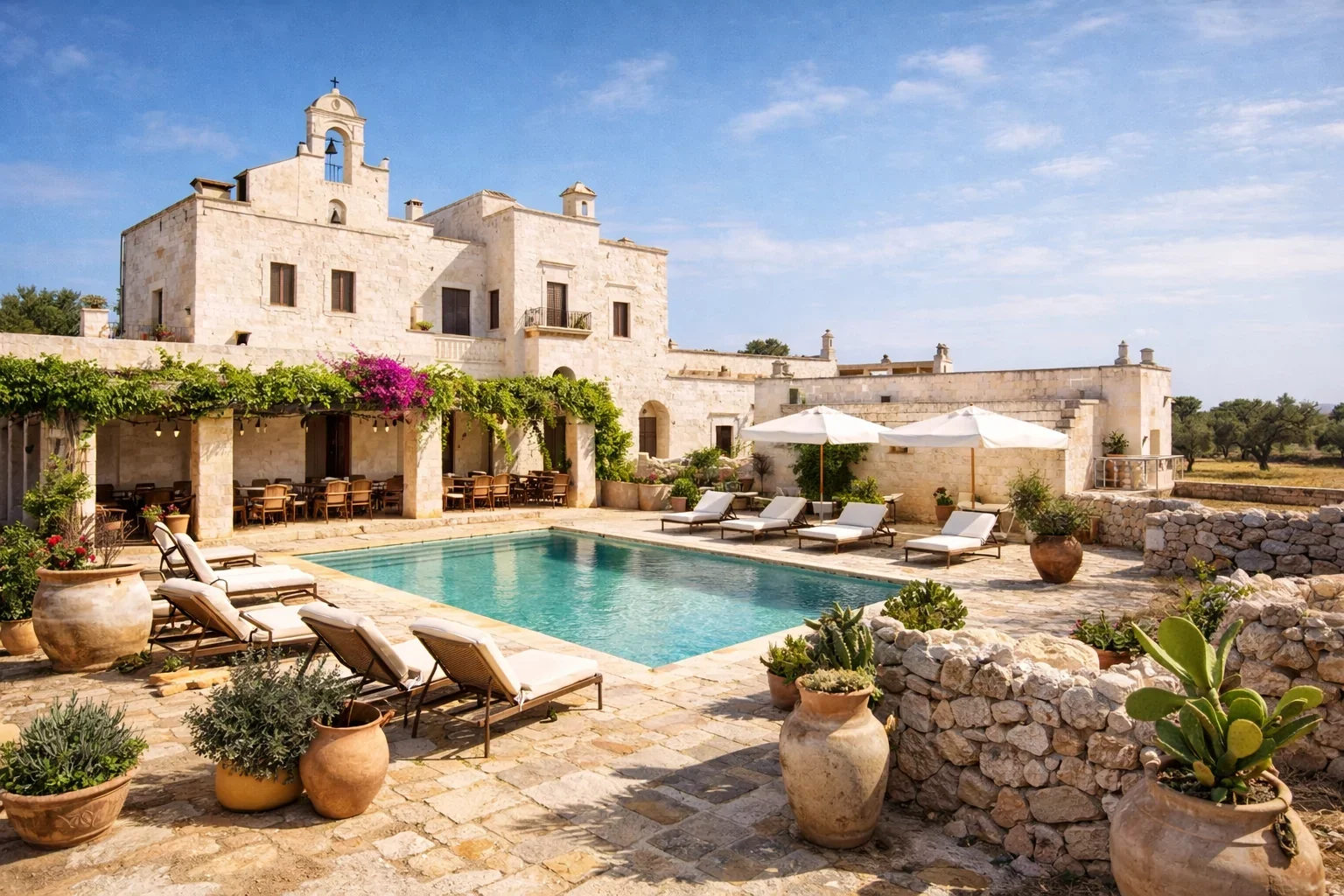
A masseria is not a house but an estate: a group of rural buildings run as a farm, typical of southern Italy and of Puglia in particular. Its history is long.
In a study published in 2010, Marco Giorgio Bevilacqua traces the first elements of the type to the Norman period, in the eleventh and twelfth centuries. Under Swabian and Angevin rule the masseria became a self-sufficient unit whose form was shaped by defence, with the castle as its model.
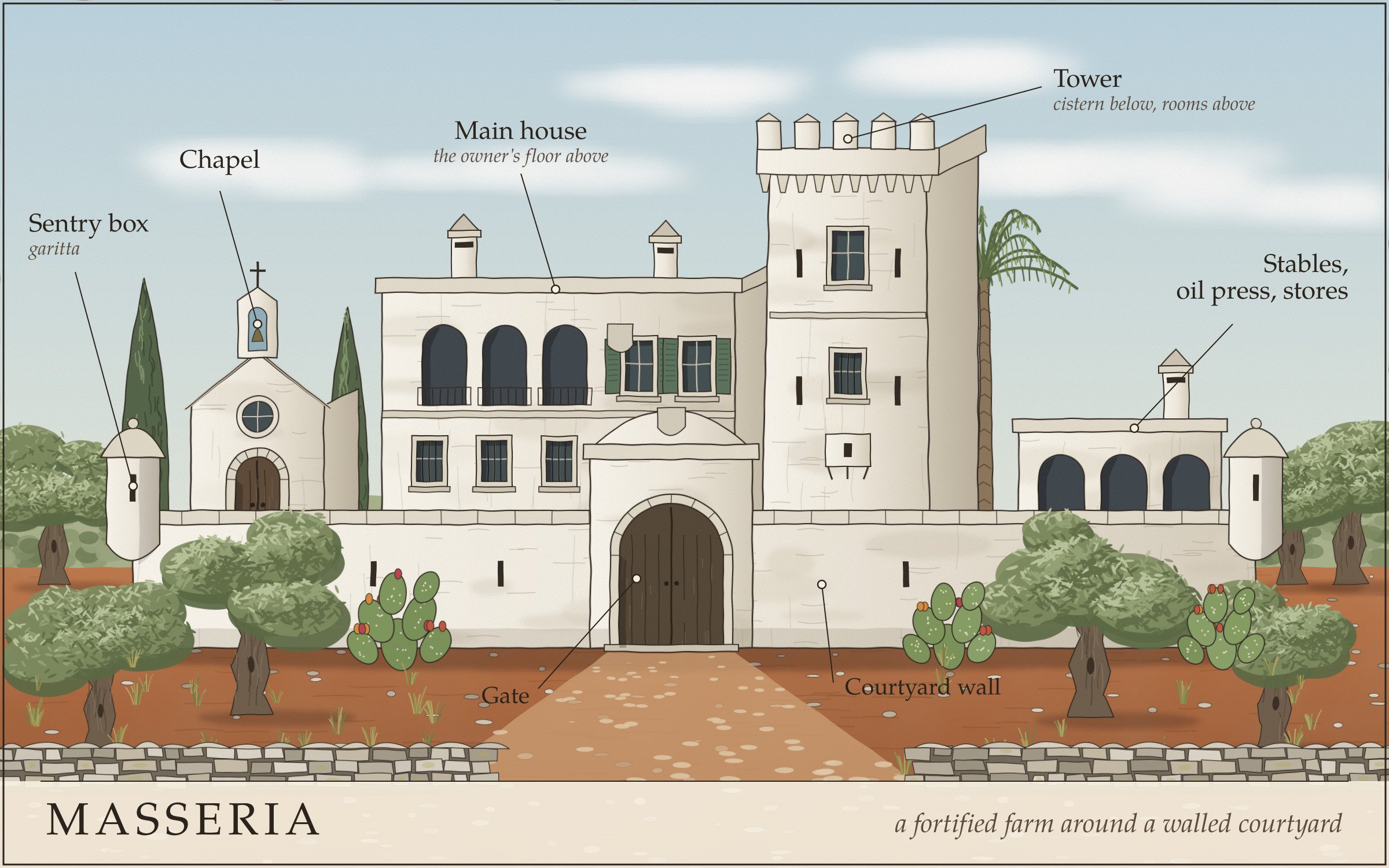
Illustration: fortyseventeen Advisory
The parts can be read like a plan. The tower is often the original core; its ground floor commonly held a rainwater cistern, with living and storage rooms above. High walls enclose the courtyard, onto which open the stables, the oil press and, in many estates, a chapel. Farms that kept sheep added jazzi, folds built on sunny, sloping ground.
Bevilacqua dates the tower masserie around Monopoli, Fasano and Ostuni to the seventeenth century, when olive and almond cultivation expanded. By the eighteenth and nineteenth centuries the corner turrets and sentry boxes had lost their military purpose and remained as ornament.
Beyond the farm
The countryside is only half of the vocabulary. The towns and the coast have their own words, and some of the region’s finest architecture answers to them. The buildings named below are cited as examples of each type; none is presented here as being for sale.
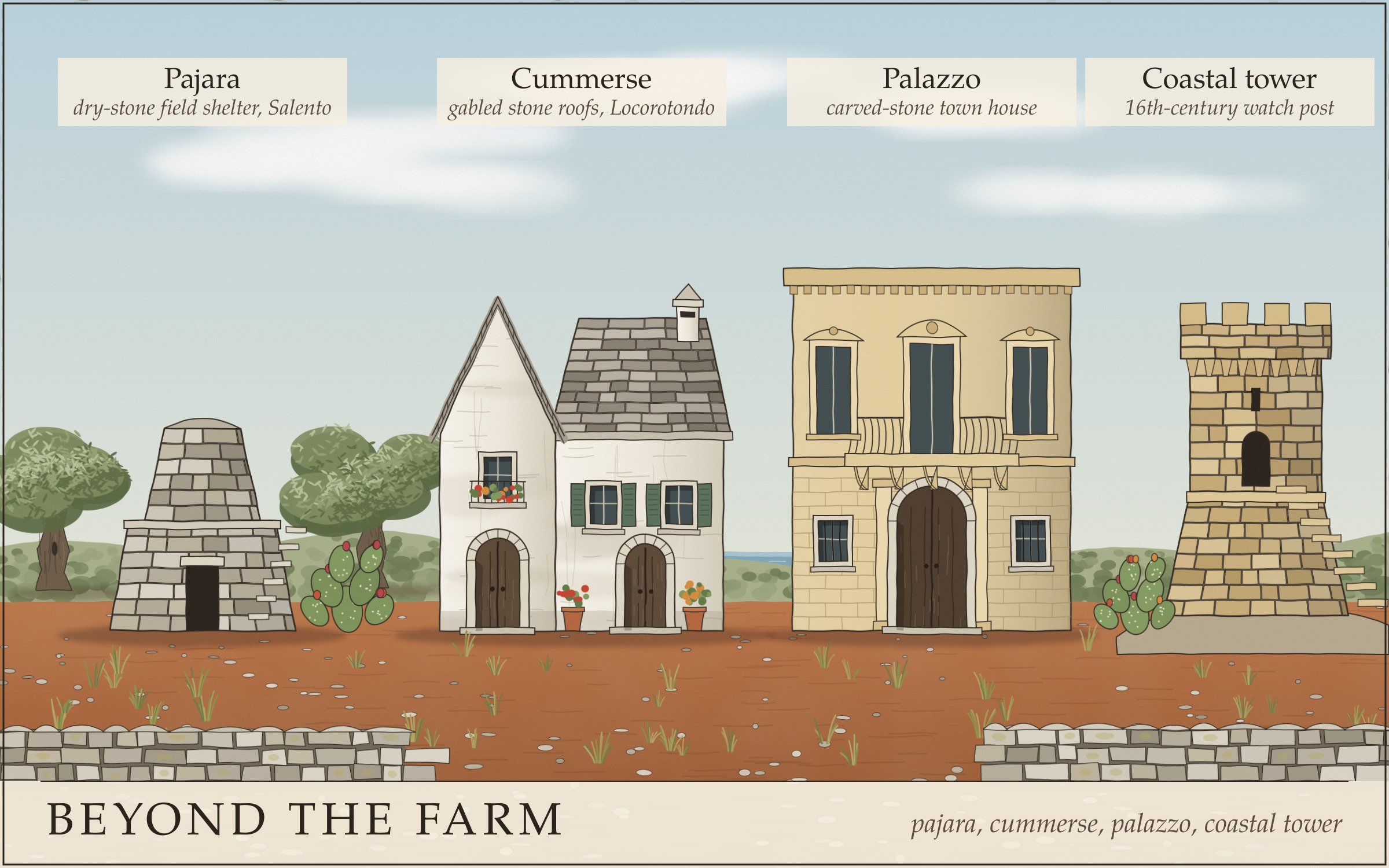
Illustration: fortyseventeen Advisory
Palazzo. The town house of a noble or landowning family, built around a carriage entrance and a first floor of reception rooms. In Lecce the type reached its height in the seventeenth century, in the style known as barocco leccese. It was made possible by pietra leccese, a soft limestone of warm, golden colour that takes elaborate carving.
Martina Franca, in the Valle d’Itria, has its own Baroque streets: the guide to the town lists Palazzo Ducale, from the seventeenth century, and palaces such as Palazzo Ancona, with two caryatids flanking its entrance.
Casa a corte. The courtyard house of the Salento towns: a dwelling arranged around a shared open space, entered from the street through a single doorway. Behind a plain wall it offers what a buyer from a large city rarely expects in a historic centre, which is outdoor space that nobody overlooks.
Cummerse. The houses of Locorotondo, whitewashed and narrow, with steep gabled roofs covered in the same limestone slabs as the trulli. The Politecnico di Bari describes them as gabled roofs raised on parabolic vaults; the Touring Club calls them the symbol of the town.
Pajara. The Salento cousin of the trullo, also written pagghiara: a dry-stone shelter in the shape of a stepped, truncated cone, used by farmers as a place to rest during the working day. In a house near Salve (Lecce) designed by Massimo Iosa Ghini, a restored pajara serves as the guesthouse.
Coastal tower. The watchtowers that punctuate both shores. Those visible today date mainly from the second half of the sixteenth century, when the Spanish viceroys ordered a chain of lookouts against raids from the sea; nearly a hundred stood in the Terra d’Otranto alone.
Villa. At Santa Maria di Leuca, where the two seas meet, landowners and aristocrats built summer residences in the nineteenth century in Moorish, Pompeian and Liberty styles. There were 43 of them by the end of the century, and the seafront is still lined with them.
What the words mean for a buyer
Each term describes a different scale of purchase, from a stone room among the olive trees to a walled compound with working land or a carved façade on a Baroque street.
They share a caution. Caroline Edwards of Personal Puglia has warned buyers that historic buildings may have undergone unauthorised alterations, and that any part added after the original period needs paperwork proving it is legal. A review of the planning record therefore comes before anything else.
They also share a promise. A deed in Puglia transfers more than square metres. It transfers a cistern cut to hold the winter rain, a tower raised against a sea that is now only beautiful, a roof laid stone on stone without mortar by people whose names nobody recorded.
That is the answer to the first question. One invests here because there will be no more of these, and because few assets can be lived in on an August evening with the shutters open and the cicadas loud in the olive trees. What remains is to choose which one, and that begins with knowing its name.
